







You’d never build a physical store with stairs but no ramp.
Yet every single day, businesses create websites that lock out millions of potential customers without even realizing it.
While your competitors overlook this valuable piece, you have an opportunity to get ahead. Web accessibility is one of the most powerful, underutilized conversion rate optimization strategies available to small businesses today.
Here’s what most business owners don’t know. Accessible web design improves the user experience for everyone who visits your site, not just people with disabilities.
When your website works well for all visitors, your conversion rates go up, your search engine rankings improve, and your brand builds the kind of trust that turns casual browsers into paying customers.
Why Accessibility Matters More Than Ever in 2026
The numbers tell a story most web designers won’t share with you.

According to the WebAIM Million 2025 report, only 5.2% of websites meet WCAG Level AA accessibility standards. That means 94.8% of websites exclude users with disabilities, and most business owners have no idea they’re doing it.
But here’s the business case that changes everything.
The World Health Organization reports that 1.3 billion people worldwide live with some form of disability. That’s 16% of the global population. This demographic controls roughly $13 trillion in annual disposable income.
When your website is not accessible, you are not just missing a compliance checkbox. You are walking away from real revenue and the chance to build an ethical online experience that includes everyone.
What happens when sites aren’t accessible?
71% of customers with disabilities will immediately leave a website they find difficult to use.
They don’t send emails asking for help. They don’t call your business. They just close the browser tab and find a competitor whose site works best for them.
The Click-Away Pound Survey found that British retailers alone lose approximately £17.1 billion every year from customers who abandon inaccessible websites. Scale that to the US market and the lost opportunity becomes staggering.
The financial performance gap is real
Companies recognized as disability inclusion leaders financially outperform their peers. Research shows shareholder returns that are 2.6 times higher over four year periods.
When you build accessible and ethical websites, you’re not just doing the right thing. You’re making a smart business decision that shows up in your bottom line.
Web Accessibility Builds Customer Trust That Converts
When brands prioritize accessibility, they send a powerful message to every single visitor.
You’re saying that every customer matters.
This commitment to inclusive design creates the kind of trust that translates directly into conversions, repeat purchases, and word of mouth referrals.
Customer loyalty metrics tell the story.

Accessible brands see roughly double the loyalty indicators compared to inaccessible competitors.
Why does accessibility drive such strong customer relationships? Because today’s consumers increasingly support businesses that demonstrate real social responsibility.
When your website works for everyone, you’re building advocates who recommend your brand to their entire network.
These customers become your marketing engine
They leave positive reviews. They tell their friends. They come back month after month because they know your business actually cares about creating an inclusive experience.
That kind of loyalty can’t be bought with advertising dollars.
Accessible Websites Convert 30-35% Better Than Inaccessible Sites
The conversion data is absolutely clear.

Accessible websites dramatically outperform inaccessible sites across every metric that matters for small business growth.
Studies show that accessible websites experience conversion rate improvements ranging from 30% to 35%.
Websites that meet WCAG accessibility standards see bounce rate reductions averaging 12% compared to sites with significant accessibility barriers.
Lower bounce rates mean more opportunities for conversion, longer engagement times, and more completed purchases or contact form submissions.
The ROI is massive
Research from Forrester shares improvements in web accessibility and user experience can yield up to a 100x return on investment. Imagine investing one dollar and getting one hundred back. Accessibility does that.
One marketing leader reported that after implementing accessibility best practices across their entire website, conversion rates nearly doubled year over year. They also saw lower bounce rates and significantly longer session durations.
These improvements offer game changing results.
Forms and Checkout Are Where Money Gets Left on the Table
Forms represent one of the most beneficial conversion points on any website. They’re also one of the biggest opportunities for accessibility improvements.
Here is where things get real.
85% of forms are completely inaccessible to assistive technologies.
81% of people have abandoned a form after they started filling it out.
67% of website visitors will abandon a form forever if they encounter any complications during the process.
Accessible forms cut abandonment in half
And the remarkable part? Accessible forms can reduce form abandonment by as much as 50%.
When forms include proper field labels, clear error messages, logical tab order, and sufficient color contrast, completion rates skyrocket.

Better checkout design alone can reduce abandonment by up to 35%. For ecommerce businesses, that can translate to millions in recovered revenue.
Simple fixes double submissions
Simple accessibility fixes like making phone number fields optional, using left aligned labels, or implementing clear progress indicators can nearly double form submissions.
These improvements benefit every single visitor, whether they use assistive technology or not.
Accessibility Features Help Everyone
This is perhaps the most powerful business case for accessible web design.
Features designed specifically for users with disabilities invariably improve the experience for your entire audience.
Clear website navigation, sufficient color contrast, and descriptive link text reduce friction for all users.
Real world accessibility benefits
Captions on videos help deaf users, but they also help people watching videos in noisy coffee shops or those who prefer reading along.
Alt text on images serves screen readers, but it also appears when images fail to load on slow connections.
Keyboard navigation supports users with motor disabilities, but it’s also faster for power users who prefer shortcuts.
Simple language helps people with cognitive disabilities, but it makes your content clearer for everyone, including non native English speakers and people who are multitasking.
Whether someone is navigating with a screen reader, using a mobile device with one hand free, recovering from eye surgery, or simply browsing in bright sunlight, accessible design makes their experience better.
Web Accessibility Dramatically Improves Your SEO Rankings
Recent data shows that websites optimized for accessibility see up to 35% better visibility in search engine results.
The technical elements that make sites accessible (semantic HTML, proper heading structures, descriptive metadata, logical navigation) are exactly what search engines need to understand and rank your content effectively.
When you build for accessibility, you simultaneously build for search engine optimization.
Google rewards accessible websites
The connection between accessibility and SEO has become increasingly clear throughout 2025.
A major study of 10,000 websites revealed an unmistakable pattern. Accessible websites consistently rank better in search results.
Search engines favor websites with features like alt text for images, proper heading hierarchies, keyboard navigation support, and clear content structure. All of these are fundamental accessibility requirements.
Core Web Vitals align with accessibility
Google’s algorithm increasingly evaluates user experience through Core Web Vitals, measuring loading speed, interactivity, and visual stability.
Websites that meet these performance standards tend to rank higher while simultaneously being more accessible to users with disabilities.
The synergy is clearer than most people think. When you invest in web accessibility, you’re also investing in discoverability and organic traffic growth.
Measurable traffic increases in just 3 months
Research from SEMrush shows that 73% of websites that implemented accessibility improvements saw a measurable increase in organic traffic.
The average traffic growth was 12% within just three months.
For small businesses competing in crowded markets, that kind of visibility boost can make all the difference online.
How to Start Making Your Website More Accessible Today
The path to accessible conversion optimization doesn’t require a complete website overhaul or a massive budget.

You can start making high impact improvements today with these practical steps.
Step 1: Get a professional accessibility audit
Begin by understanding exactly where your website stands right now.
Automated accessibility tools can identify about 30% of common issues like missing alt text or poor color contrast. However, the remaining 70% requires human review by someone who understands how people with disabilities actually use websites.
At Bay Laurel Solutions, we offer a Mini Accessibility Audit for just $279. You get a human reviewed report that checks your most important pages for accessibility, readability, and usability issues.
The report includes screenshots of specific problems and simple “Fix Now / Fix Later” recommendations you can share with your development team.
Book your Mini Accessibility Audit here
Step 2: Fix high impact issues first
Focus first on the areas that directly affect conversion rates and user experience.
Start with these improvements that deliver immediate results.
Make sure all form fields have clear, visible labels that tell users exactly what information you need.
Add descriptive alt text to every meaningful image on your site.
Verify sufficient color contrast ratios (at least 4.5 to 1 for body text, 3 to 1 for larger text and interactive elements).
Enable full keyboard navigation so users can complete every action without needing a mouse.
Provide clear, specific error messages in forms that tell users exactly how to fix problems.
Structure your content with proper heading tags (H1, H2, H3) that create a logical hierarchy.
These changes improve the experience for everyone. Users with visual impairments benefit from screen reader compatibility. Older adults appreciate larger text and better contrast. Mobile users find keyboard navigation helpful when forms are difficult to tap. Everyone benefits from clearer instructions and better organized content.
Step 3: Test with real users who have disabilities
Automated scans are notorious when it comes to missing usability issues that only become apparent when real people try to use your site.
Test your website with actual users who rely on assistive technologies like screen readers, voice recognition software, or keyboard only navigation.
Their insights will reveal barriers you never knew existed and help you prioritize fixes that make the biggest difference. This kind of user testing is invaluable for understanding the real world impact of your design decisions.
Step 4: Build accessibility into every new project from day one
Rather than retrofitting accessibility after launch, integrate it into your website design process from the very beginning.
This saves time, reduces costs, and creates better results. When accessibility is baked into your design system, every new page and feature you add will already work for all users.
Before you hire a web designer or developer, ask these five questions.
What WCAG compliance level do you follow (Level A, AA, or AAA) and how do you test for accessibility throughout the project?
Do you design with accessibility integrated from the start of every project, or do you add it later?
Can your websites be fully navigated using only a keyboard, without a mouse or trackpad?
How do you make sure text and color contrast remain clear and readable across all devices and screen sizes?
Will every image include accurate alt text for screen readers, and who writes that content?
Step 5: Keep monitoring and maintaining accessibility
Accessibility isn’t a one time project. It’s an ongoing commitment.
Regular testing, updates, and monitoring ensure your site remains accessible as you add new features and content. Schedule quarterly accessibility audits to catch issues before they become problems. Train your content team to write good alt text and maintain proper heading structure. Make accessibility part of your quality assurance process for every website update.
The Business Case for Accessibility Is Overwhelming
When we examine the full picture, accessibility emerges as one of the smartest investments you can make for small business growth.
Consider what you gain when you prioritize accessible web design.
Expanded market reach to 1.3 billion potential customers with $13 trillion in spending power.
Higher conversion rates with improvements of 30 to 35% across accessible websites.
Improved SEO performance with better rankings, more organic traffic, and increased visibility in search results.
Reduced legal risk and protection from costly lawsuits and ADA compliance issues.
Enhanced brand reputation by standing out as an inclusive, socially responsible business.
Better user experience for everyone, with benefits that extend far beyond users with disabilities.
Increased customer loyalty with retention rates roughly double compared to inaccessible competitors.
The ROI is exceptional
Research from Forrester shows that accessibility improvements generate an ROI of $100 for every $1 invested.

With acquisition costs for new customers running 5 to 25 times higher than retention costs, the financial case for accessibility becomes even more compelling.
Think about it this way. You’re already paying for website design, development, and maintenance. When you build with accessibility in mind from the start, you’re not adding a separate project. You’re making sure your existing investment actually works for your entire potential audience.
The Future Is Inclusive and 2026 Is Your Opportunity
As legal requirements tighten globally (with the European Accessibility Act in full effect and ADA Title II rulemaking approaching), accessibility is transitioning from competitive advantage to baseline expectation.
Organizations that wait face not just legal exposure but market share loss to competitors who’ve already made the shift.
The companies seeing the best ROI from accessibility aren’t waiting for perfect conditions or comprehensive budgets. They’re starting now, making incremental progress, building momentum, and reaping the rewards.
The question isn’t whether to invest in accessibility
The data clearly demonstrates its value.
The question is whether you’ll lead the shift or scramble to catch up later.
When your site works for everyone, you unlock new audiences, improve conversion rates across the board, strengthen brand loyalty, and future proof your business.
Accessibility isn’t just the right thing to do. It’s the smart thing to do.
Ready to See Where Your Website Stands?
Want to know if your website works for everyone?
Understanding your current accessibility gaps is the first step toward higher conversions and a more inclusive digital experience.
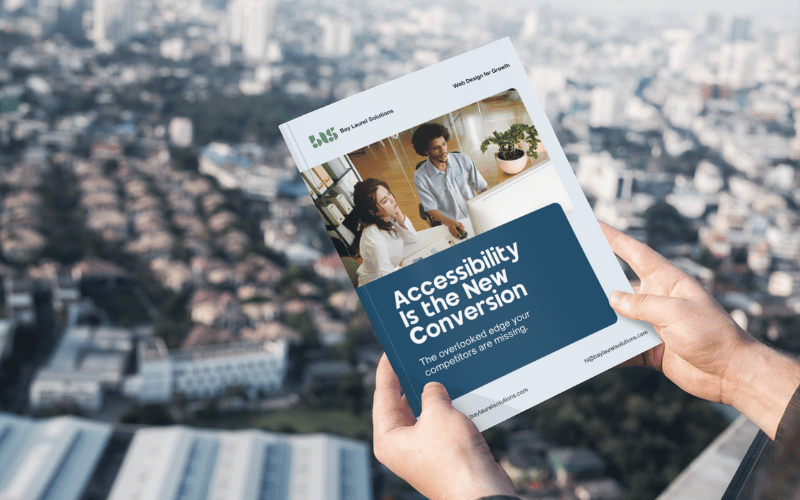
Download Your Free Accessibility Guide and get practical strategies, checklists, and expert insights to start building a website that welcomes everyone and converts better.
Or schedule a conversation with Bay Laurel Solutions to learn how accessibility improvements can drive measurable growth for your business.
We’re a women led, LGBTQ+ web design agency based in San Francisco. We help small businesses grow online with values driven websites that support sales, donations, and thriving communities.
Because in 2026, the most successful websites aren’t just beautiful. They’re accessible to all.
Book your Mini Accessibility Audit today and get a clear, actionable roadmap for making your website work better for everyone.
Research sources: World Health Organization, WebAIM Million Report 2025, Click-Away Pound Survey, Forrester Research, Web Content Accessibility Guidelines (WCAG), Americans with Disabilities Act (ADA)