







Quick Summary
This is a practical, interactive audience research checklist designed to uncover real client motivations before you rewrite your website, adjust your positioning, or launch something new.
Here’s a scene that plays out constantly in small businesses everywhere. Someone spends weeks building out a new offer. They nail the website copy, get the pricing right, design a clean proposal. They launch. And then… crickets.
So they tweak the headline. Adjust the price. Try a different color button. More crickets.
The problem is almost never the button. Instead, they built the whole thing based on what they assumed their clients wanted — not what clients actually said, in their own words, when asked the right questions.
💡 The hard truth: Most businesses skip real audience research entirely. Those who do it often do it wrong, asking people what they “like” rather than what kept them up at night before they found a solution. This checklist is about doing it right.
Everything here is actionable. Work through it before you launch something new, before you rewrite your website, or before you wonder why your conversion rate is stubbornly stuck.
The checklist is interactive, check items off as you complete them. Let’s go.
Set Up Your Audience Research the Right Way
Before You Talk to Anyone, Do This
Jumping straight into customer interviews without a clear objective is like driving somewhere new without a destination. You’ll end up somewhere – probably not where you needed to be.
The goal here is to set up a research process that’s focused, efficient, and actually linked to decisions you need to make.
The golden rule: if the insight you gather wouldn’t change any decision, you don’t need it.

🎯 Setup Checklist
⚠️ Common mistake: Setting vague goals like “improve messaging” with no measurable outcome attached. Every research session should end with at least one decision you can now make that you couldn’t make before.
Conduct Direct Customer Research
The Conversations That Change Everything
This is where most businesses either skip entirely or do badly.
Bad audience research asks people what they want. Good audience research, however, uncovers what they’re actually driven by, and those are almost never the same thing.
This is where your audience research checklist starts producing real insight instead of surface-level feedback. Five to ten interviews with ideal clients is enough to identify meaningful patterns. Because the goal isn’t statistical significance, but language, you’re listening for the exact words and phrases your clients use to describe their own problems. That’s why those are the words that should show up in your marketing copy.
💡Real world example: In 2011, Patagonia ran a full-page Black Friday ad telling people not to buy their jacket. Sounds insane. But they knew their audience well enough to make that bet. Through years of listening, they understood their customers were environmentally conscious people who trusted brands that told hard truths over brands that just sold things. The assumption most companies hold – that customers want to be persuaded – was wrong for Patagonia’s audience. Knowing that changed everything. Sales grew 30% the following year.

🔎 Direct Research Checklist
❌ Weak survey questions
- What features do you want?
- How satisfied were you?
- Would you recommend us?
- What did you like about X?
✅ Questions that get answers
- What frustrated you most before finding a solution?
- What almost stopped you from moving forward?
- What did you try before this that didn’t work?
- What would have made you not hire us?
Map the Emotional Customer Journey
What They Feel, Not Just What They Do
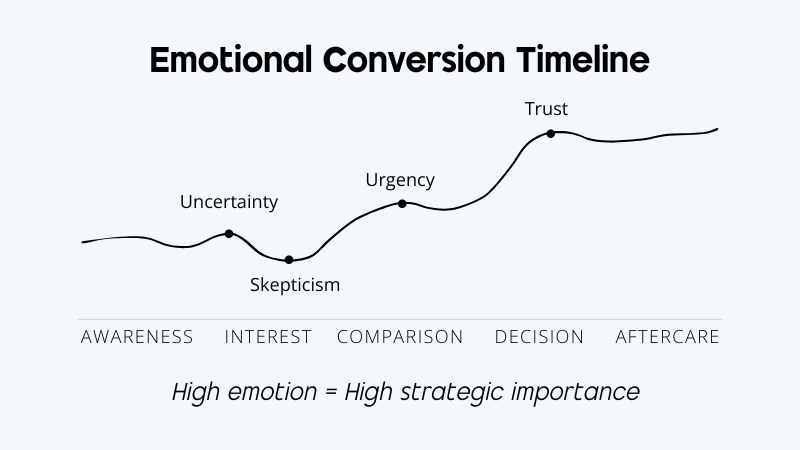
A customer journey map isn’t a flowchart. It’s an emotional timeline. You’re not just documenting the steps from “finds you online” to “signs the contract” – you’re mapping where uncertainty lives, where urgency spikes, and where trust either builds or collapses.
High emotion equals high strategic importance. If you know the exact moment a prospect gets skeptical, you can address it before it becomes a lost deal.
68%
of customers leave because they feel the company doesn’t care
5–9×
more expensive to acquire a new customer than to retain an existing one
1 in 26
unhappy customers bother to complain – the rest just leave quietly
📍 Journey Mapping Checklist
Turn Research Into Insight
Turning Your Audience Research Checklist Into Something Useful
You’ve gathered the data. Now the work is making sense of it without projecting your own assumptions back onto it. This is harder than it sounds. Most business owners read customer feedback and see confirmation of what they already believed. Resist that.
✅ The three-lens framework: Sort every insight into one of three categories – functional needs (what problem they need solved), emotional needs (how they want to feel), and identity drivers (how they see themselves). Messaging that addresses all three is significantly more effective than messaging that only addresses one.
🔍 Analysis Checklist
Translate Research Into Messaging and Offers
Actually Using What You Learned
This is the step where most research dies. You have insights, themes, and a thick folder of transcripts. And then… the next project lands, the insights get filed, and six months later you’re doing the same guesswork as before.
If you skip this step, your audience research checklist becomes a document you file away instead of a decision-making tool.
The point of research is decisions. Make them.
📐 Implementation Checklist
Validate Before You Scale
Because Assumptions Are Expensive
You’ve done the research, built the offer, and written the copy. Now, before you invest heavily in rollout, you validate your assumptions with real behavior – not more opinions.
Behavior reveals truth in ways that surveys simply can’t. In other words, someone saying “yes, I’d pay for that” and someone actually clicking “buy” are wildly different data points.
📊 Validation Checklist

Start Small. Start Now.
This audience research checklist covers a lot of ground. The reality is, if you tried to do all of it this week, you’d do none of it well.
So here’s a practical starting point:
🚀 Start here: Pick one person you’d genuinely love to have as a client. Reach out this week and ask if you can talk for 30 minutes about their experience navigating the problem you help solve. No sales pitch. Pure curiosity. One conversation like that will teach you more than a month of guessing.
The businesses that consistently attract ideal clients and convert at high rates aren’t smarter than everyone else. They just know their audience better. And that’s not a talent – it’s a process. One you can build systematically, starting today.
If you want help building out a research process specific to your business – the interviews, the analysis, the messaging translation – that’s exactly the kind of work we do. We’d be glad to talk through it.